Multilogin Page A/B Experiment
Redesigned the session-limit page into a 2-step flow — turning a dead-end friction wall into a trial conversion moment.
The right amount of friction isn't a bug — it's a conversion lever.
Context
When a user account exceeds its allowed number of simultaneous active sessions, the platform shows a dedicated Multilogin page. This page exists at the intersection of two competing interests: it should create enough friction to discourage credential sharing and nudge users toward purchasing additional licences — but not so much friction that it drives them to churn entirely.
The original page handled both goals on a single screen. The hypothesis was that splitting the interaction into two steps — first acknowledging the situation, then presenting the commercial offer — would improve conversion without increasing churn.
Problem
Immediate upsell felt abrupt
Landing directly on an invite/purchase screen after a session block gave users no moment to understand what had happened. The ask felt premature.
No acknowledgement step
Users who hit the page hadn't necessarily decided to credential-share on purpose. The page assumed they had and jumped straight to monetisation.
Friction-to-churn risk
Any redesign that increases friction also carries churn risk. The experiment needed to prove the change was net-positive before rolling out.
Friction, placed correctly, builds intent.
Hypothesis
A 2-step flow — a friction/awareness screen first, followed by the upsell/invite screen — would give users a moment to process the situation before being presented with an offer. That moment of intent-building would increase the quality of users reaching the commercial step and lift the trial conversion rate.
The Design — Before vs After
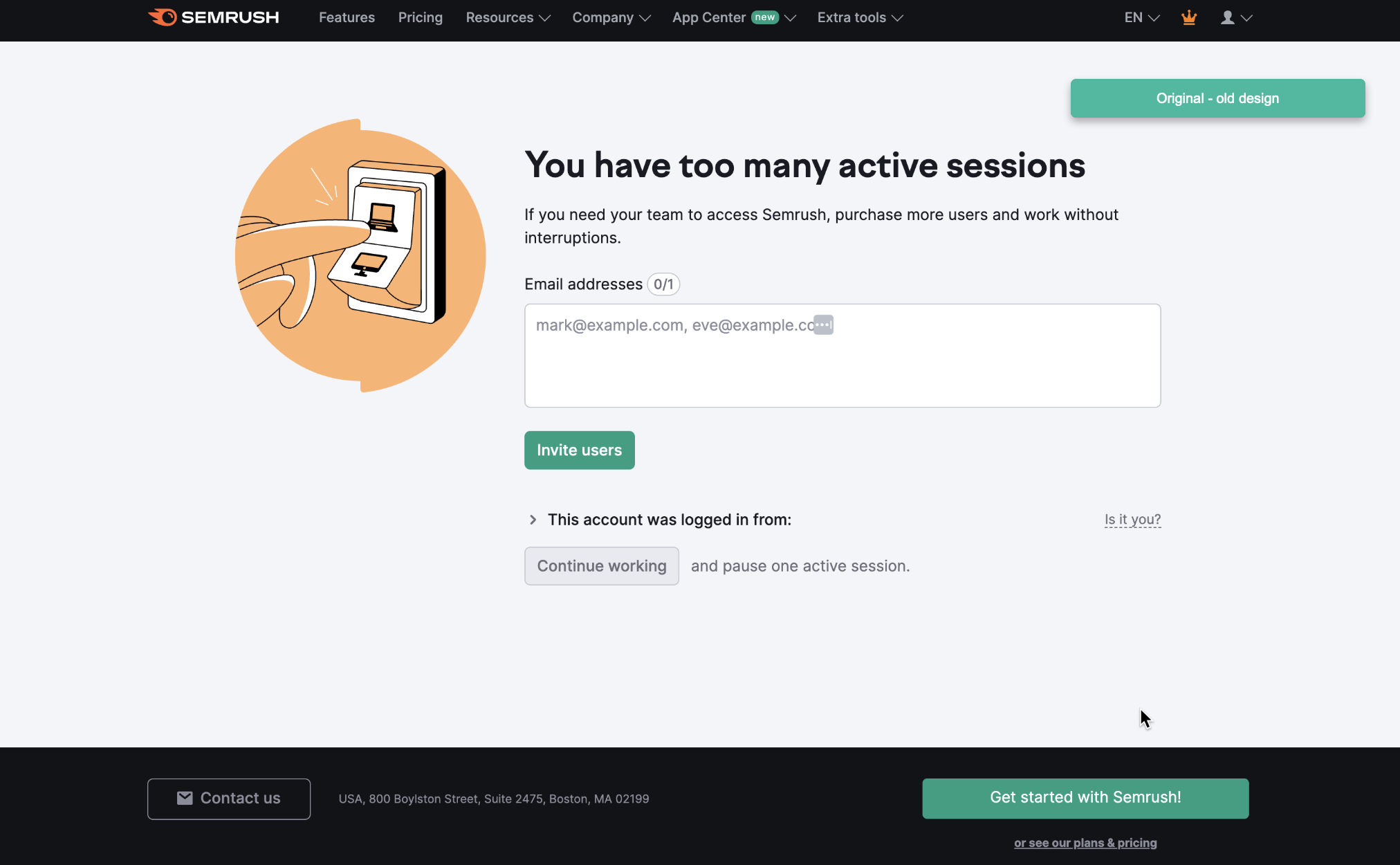
The control was a single-screen design. All information — the warning, the invite form, and the upsell — appeared at once, with no separation between the friction moment and the commercial ask.
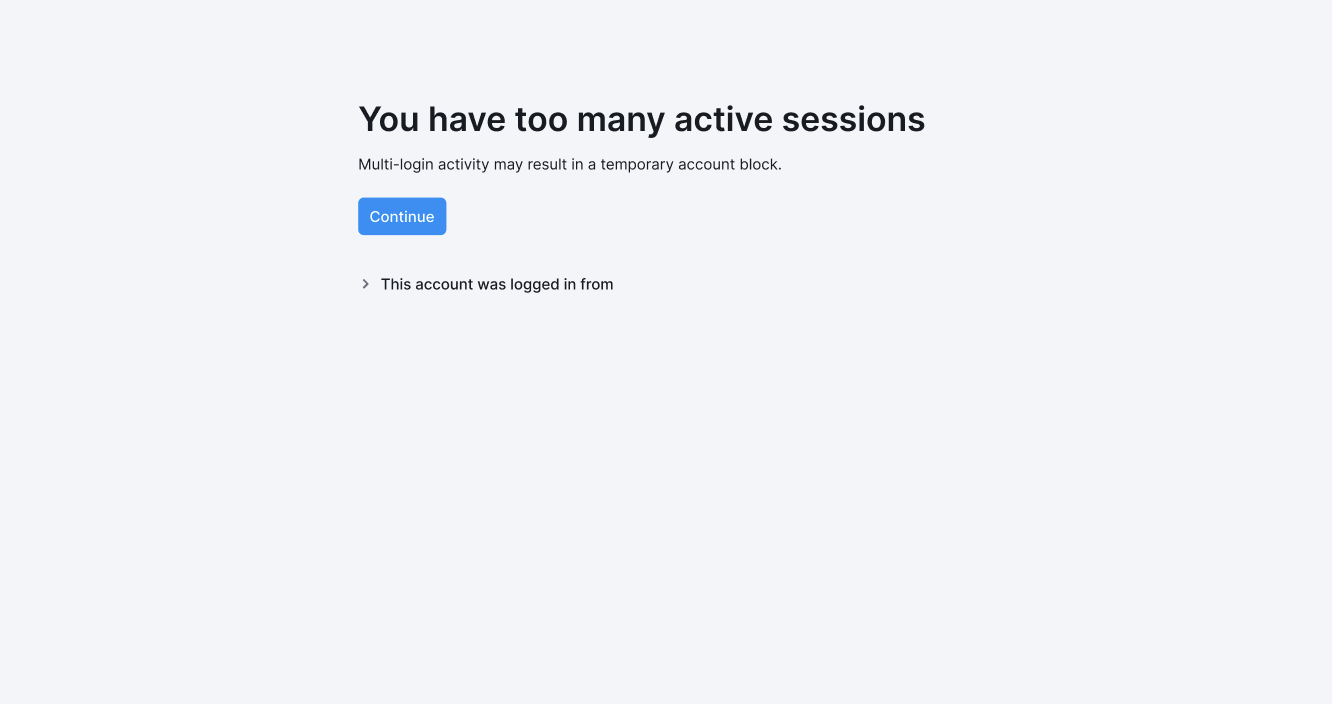
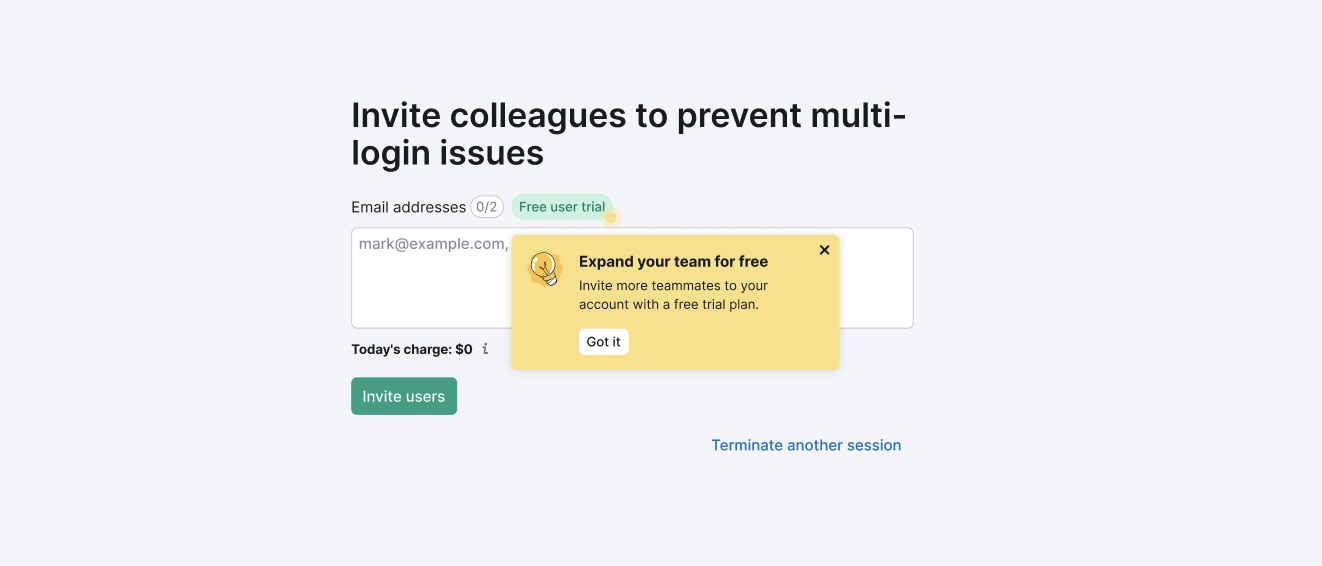
The variant split this into two distinct steps. Step 1 is a minimal friction screen — it names the problem and gives the user a single action: continue. Step 2 surfaces only after the user has consciously proceeded, and leads with the value offer (free trial for colleagues) rather than a hard upsell.
Two steps turned an interruption into a decision.
Experiment Design
- Audience. Everyone who lands on the Multilogin page. Sticky assignment, so a user always saw the same variant across visits.
- Split and sample. 50/50, powered for an absolute lift of +0.2pp (α = 0.05, power = 80%). Actual exposure cleared the required sample well inside the window.
- Duration. A month live, then a 14-day cooldown to catch conversions that land after exposure.
- Package test. Several changes shipped together, and that was accepted upfront — attributing the lift to any single one of them was out of scope.
+35.5% trial conversion. A third more trials started. Churn never moved.
Results
- +35.5% trial conversion rate, statistically significant. The primary metric moved and held — not a directional wobble.
- +34% more trials started. The rate went up and the volume with it, so this wasn't a smaller group converting better.
- +3.1% trial-to-purchase, directionally positive but not significant on its own. Multiplied by the extra trial volume it still came out as a real lift in paid conversions.
- Churn: no measurable change. The added friction cost nothing at the other end — the secondary condition for shipping.
- The trials turned into payments, averaging $79 per converted user across the first two weeks after launch.
The decision: the experimental variant won. 2-step Multilogin flow rolled out to all users.
Why This Matters
This case is about the design of a friction moment — a place most designers would treat as a problem to minimise. The insight here is that friction, placed correctly, builds intent. Users who click through a warning screen have consciously decided to engage with what comes next. That decision changes the quality of the subsequent interaction.
The 2-step flow didn't just increase a metric. It changed the nature of the user arriving at the commercial offer: from someone interrupted mid-session to someone who has just acknowledged a situation and chosen to continue.
Related Experiments
Before the 2-step flow, we tried two other angles on the same friction point. Offering a free trial right on the Multilogin page won: conversion to paid rose from 2.2% to 2.8%, and most people who took the trial went on to pay for it. A separate test opened the invite form directly on the Collaboration landing page. It showed no real difference from the original, so we kept the simpler version.
More cases