Next Steps After Invite
Monetize the peak-motivation moment right after a successful invite — a recommendation card with a toggle, surfaced inside the same modal instead of leaving the user with no next step.
Overview
Problems
- After a successful invite, the user is "abandoned" — no next step, no further engagement.
- The success moment is the account owner's peak motivation, but it is not monetized.
- An invited sub-user has limited access by default — no hint on how to unlock more tools.
- MRR hypothesis: recommending a relevant add-on right after invite can convert to purchase.
Goals
- Monetize the successful invite moment — offer a relevant toolkit for the invitee.
- Help the owner see the value of extending access for the team.
- Fit the recommendation organically into the existing flow — do not break UX.
- Map all invite entry points and pick the optimal upsell slot.
Solutions
Variant B — success-step inside the existing widget instead of a separate modal:
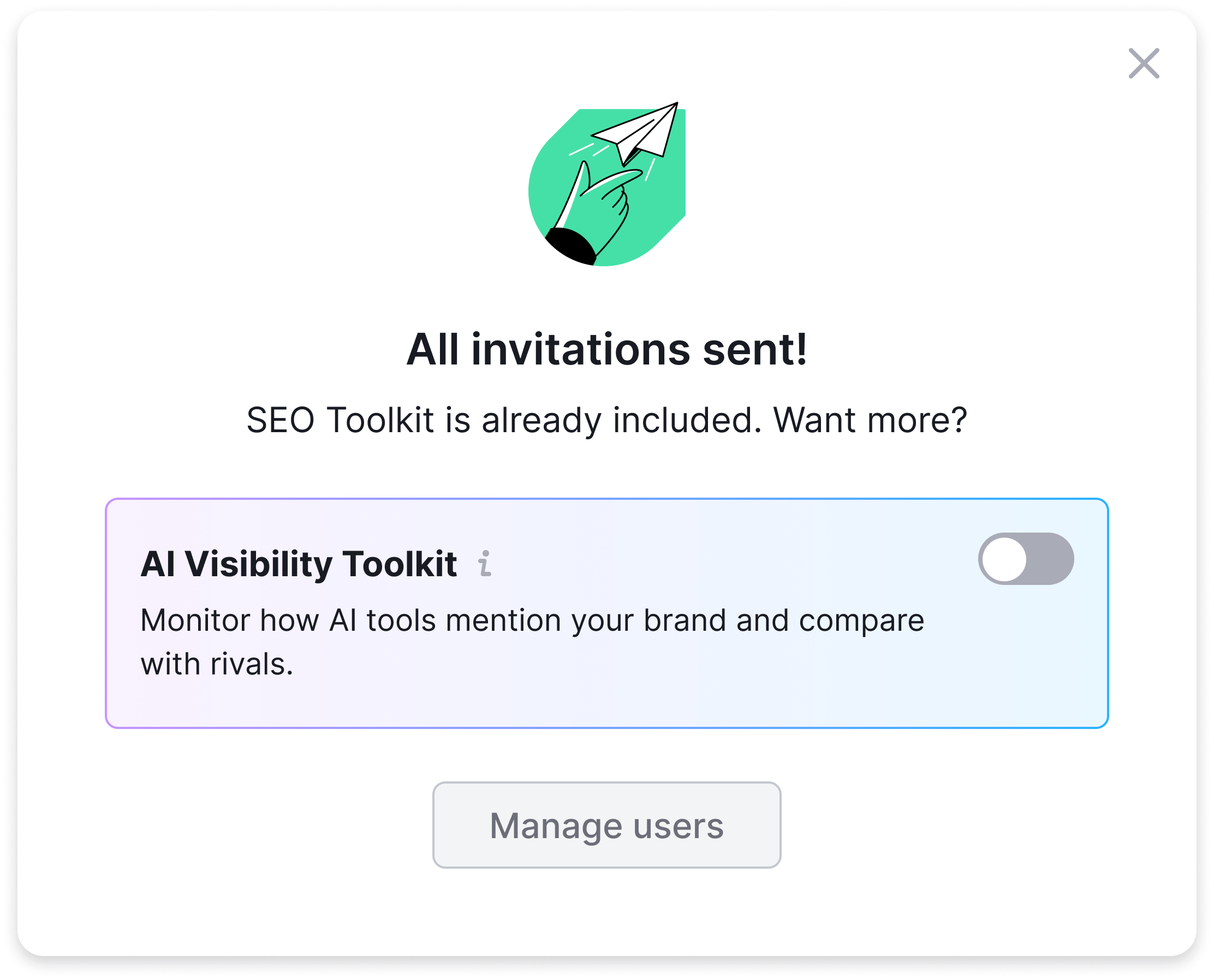
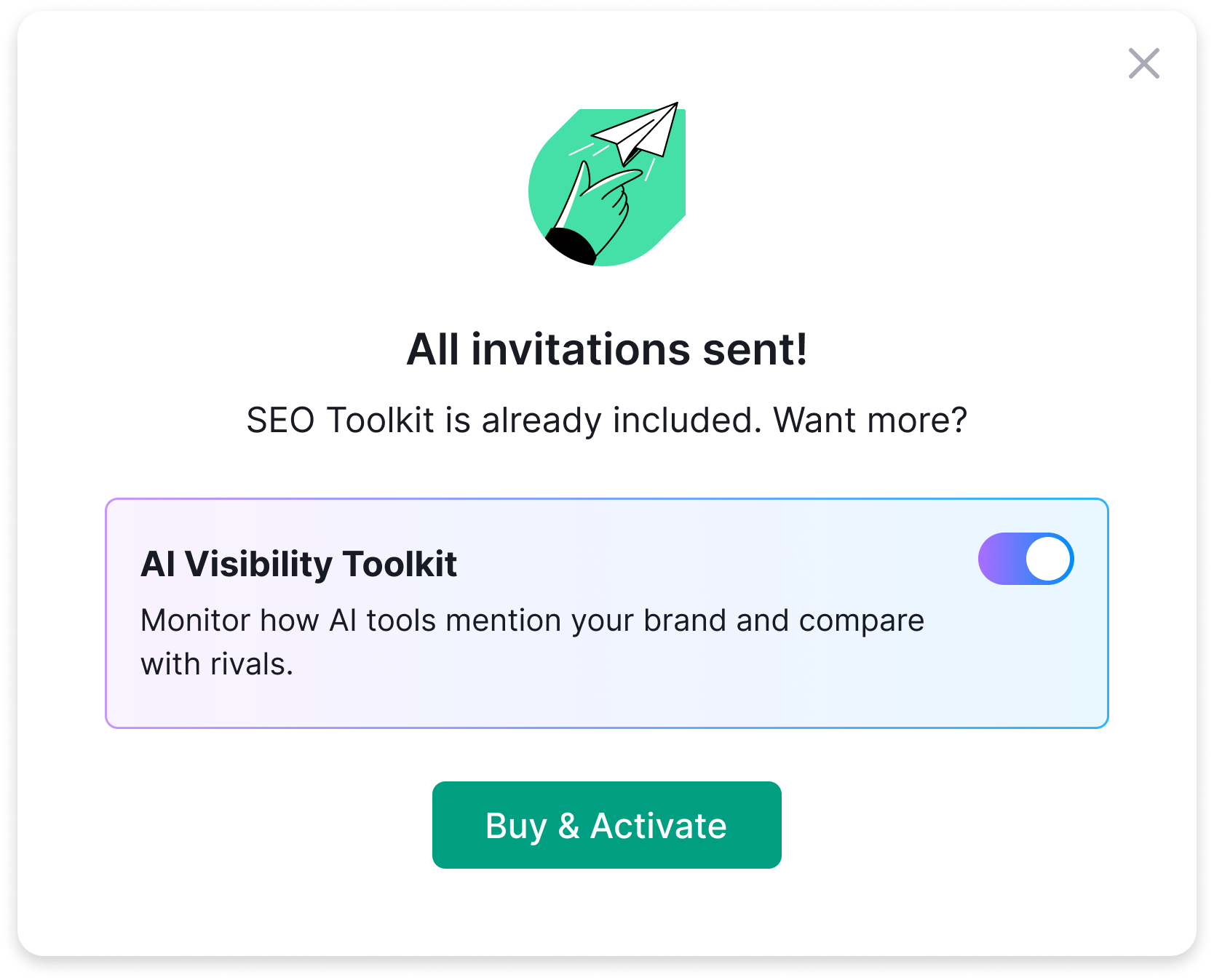
- After "Invite sent", the same modal switches to step 2 — success confirmation plus an upsell card.
- Step 2: confirmation message + recommended add-on toolkit card with a toggle.
- Toggle ON → primary CTA "Buy & Activate" → separate payment popup (owned by the add-on product team).
- Toggle OFF → secondary CTA "Manage users" — neutral exit, no pressure.
- After payment → the other team's "Toolkit added" widget (confetti). "Got it" → user stays on the current page, no forced redirect.
Metrics
- CTR on the upsell offer after invite.
- Conversion to add-on purchase from the upsell moment.
- MRR uplift from add-on purchases sourced from post-invite upsell.
Where the Idea Came From
This is the highest-motivation moment in the entire collaboration flow. The user just decided to bring someone new into their account — they're engaged, in action mode — and we give them nothing to do next.
Key Decision — No Forced Redirect After Purchase
After purchase, a natural instinct is to redirect the user to User Management to "see" what they just activated. I explicitly chose not to do that.
Widget belongs to another team
The purchase confirmation widget is owned by the add-on product team. I have no control over its post-purchase state — fewer assumptions = safer integration.
User could be on any page
The invite flow starts from 4 different entry points. A redirect to User Management would be unexpected from most of them.
Purchase is complete
The transaction succeeded. Further navigation is the user's choice — forcing a redirect would feel presumptuous.
Discovery Process
-
01
Map all invite entry points
Top Menu, User Management page, Sharing Widget, Multilogin. Each has different context and user intent. The post-invite gap existed in all of them.
-
02
Research the add-on purchase flow
The add-on toolkit belongs to a separate product team. Reached out to 3 engineers from that team to understand technical constraints: what can be activated, when, and by whom.
-
03
CJM video walkthrough with PM
Presented the gap discovery via video before proposing any solution. PM alignment on the problem before any design work.
-
04
Simplify from wizard to toggle
Initial design was a multi-step wizard. PM feedback: too heavy. Simplified to a single toggle — one decision, one action.
Why This Matters
This case isn't about a shipped feature — it's about the kind of self-initiated work that finds tasks worth assigning. The CJM revealed a systemic gap. The concept above is one answer to it. Even as a concept, it gave the team a concrete artefact to align on instead of an abstract "we should monetize this moment."